To get brand deals, pick a clear niche, make a short media kit with your typical views, and pitch brands that already sponsor creators in your niche with one specific content idea. Follow up twice, agree fee, deliverables and usage rights in writing, then deliver, report results and pitch the next collaboration. A big following isn’t required.
I’ve spent 16+ years in social media, formerly as a social media marketer and branding expert, and since 2020 I’ve focused on brand collaborations. My advice is simple: treat brand deals as outreach you control, not something you wait for.
This guide covers the full process, with templates, notes for 14 niches and real email threads from a creator we represent, from first pitch to signed agreement.
What counts as a brand deal?
A brand deal is a paid or gifted partnership in which a business works with a creator on content about its product or service. Before you quote or say yes, know which type is on the table, because the deliverables, rights and payment differ:
| Deal type | What you provide | How you get paid |
|---|---|---|
| Flat-fee sponsorship | Agreed posts, videos, integrations or Stories on your channel | A fixed fee for a defined scope |
| Affiliate partnership | Content with a tracked link or discount code | Commission on qualifying sales or sign-ups |
| Gifted collaboration | Content in exchange for a product, stay or service | The product or experience, not cash |
| UGC creation | Photos or videos for the brand’s own channels or ads | A production fee, with usage rights set in writing |
| Ambassador or multi-month deal | Recurring deliverables over several months | A monthly retainer or a fee per deliverable |
With UGC, the brand is buying content for its own channels, so confirm in writing whether posting on your feed is included or priced separately.
Are you ready to pitch (even with a small following)?
There’s no universal follower minimum for direct brand deals. Each brand sets its own criteria, separate from the minimums some platform marketplaces use (Kolect).
No universal follower minimum for direct brand deals: each brand sets its own criteria
1,000 followers to take part in TikTok One projects (a platform marketplace rule)
Sources: Kolect and TikTok Business Help Center
Here’s what I look at instead:
Ready-to-pitch checklist
- A clear niche. A marketer can tell within ten seconds who watches you and why.
- Consistent recent posts. Your last 10 to 15 posts show steady lighting, audio, pacing and storytelling.
- Honest typical numbers. You know your usual views and engagement, and you don’t lean on one old viral hit.
- Natural product fit. A brand can picture its product in your normal format.
- Capacity. A business email ready to go, and time to deliver on deadline.
If your audience is small, start with tightly scoped paid deliverables or UGC. Some UGC platforms, such as Billo, accept creators without a social following if they meet the platform’s other requirements. For direct sponsorships, read our guide to brand deals for small creators.
Should you wait for brands to find you?
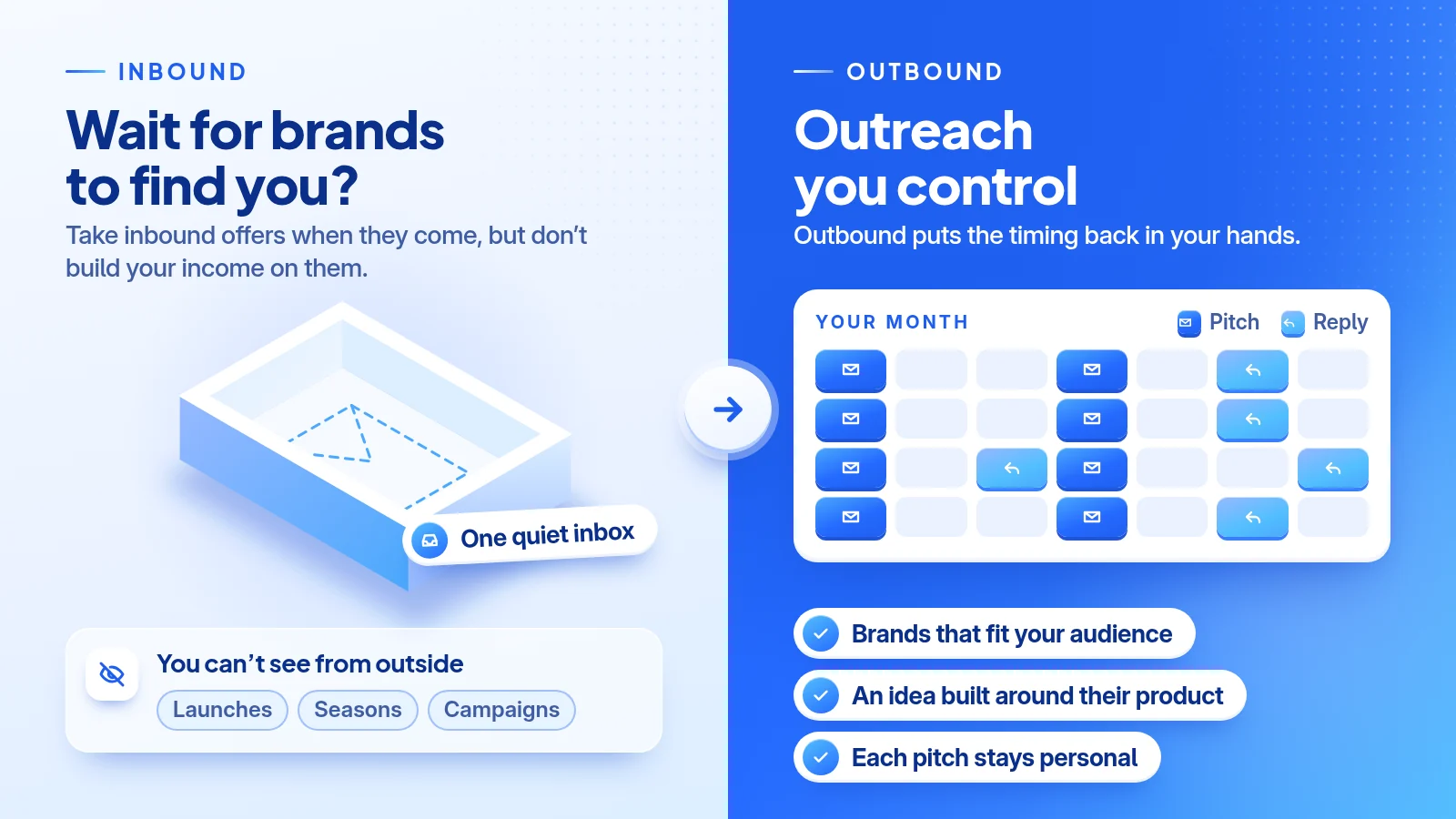
Take inbound offers when they come, but don’t build your income on them. A marketing manager can’t book a creator they’ve never heard of, and brands plan creator budgets around launches, seasons and campaigns you can’t see from outside.
Treat brand deals as outreach you control, not something you wait for.
Outbound puts the timing back in your hands. You choose brands that fit your audience, pitch an idea built around their product, and keep enough conversations open that one quiet inbox doesn’t stall your month. Volume matters, but only if each pitch stays personal; a copy-paste blast is easy to ignore.
How do you get brand deals, step by step?
These seven steps apply in any niche. Once you’re set up, steps 3 to 6 become a weekly routine.
The seven steps at a glance
- Set up once
Define your niche, audience and offer
Get your positioning into one sentence a busy marketer understands straight away.
- Set up once
Build a short media kit
Keep it to one or two pages, with median views rather than the average.
- Weekly routine
List brands that already sponsor creators
Your best prospects are brands already paying creators. Then find the right contact.
- Weekly routine
Send a personal pitch
A real reason you picked this brand, and one specific content idea.
- Weekly routine
Follow up without being pushy
Follow up twice, in the same thread.
- Weekly routine
Negotiate scope, price and usage rights
Never send a bare number.
- After each deal
Deliver, disclose, report and pitch the next one
Send a recap with honest numbers and an idea for round two.
1. Define your niche, audience and offer
Get your positioning into one sentence a busy marketer understands straight away:
I create [content format] for [specific audience] who want to
[solve a specific problem or reach a goal].
Then turn it into something a brand can buy. A food creator might offer a weeknight recipe built around one ingredient. A finance creator might walk through a monthly budget in an app. A parenting creator might test a stroller or a bedtime-routine tool in real family life.
Cover several topics? Lead each pitch with the part of your content that fits that brand.
2. Build a short media kit (with median views)
Keep it to one or two pages:
- Your positioning, channels and contact email
- Audience demographics and top locations from your analytics
- Typical views and engagement by format (Reels, Stories, long-form video)
- Two or three relevant examples and any past partnerships, labeled accurately
- Your core packages
Tip
No previous brand work? Make two or three sample videos with products you already own, label them honestly as examples rather than past sponsorships, and pair them with your recent typical views.
State the date range, such as the last 30 or 90 days, and use median views rather than the average. SponsorRadar recommends pricing from median views, and the same logic applies to your kit: one viral video inflates an average, and a brand that books you on that number will be disappointed by a normal result, which makes a renewal harder. YouTube’s own tips also suggest including audience information, views, watch time, demographics and collaboration ideas (YouTube Help).
Have it ready before you pitch. In a GoHighLevel thread for a tech and AI creator we represent, the brand’s first reply, after our follow-up, was:
“Do you have a media kit? Would love to hear more.”
Build yours with our creator media kit guide.
3. List brands that already sponsor creators, then find the right contact
Your best prospects are brands already paying creators. Start with products you use and like, then brands sponsoring creators similar to you (check disclosed posts, video descriptions and tagged brand accounts), then those sponsors’ competitors.
SponsorRadar and Meet Sponsors make the same point: target brands that already sponsor. Check post dates so you pitch current campaigns, not a one-off from years ago. A simple sheet (brand, fit, contact, angle, pitch date, follow-ups, status) keeps every thread moving.
To find the right person, work in this order:
Where to find the right person
The brand’s website.
Look for Partnerships, Creators, Affiliates, Press or a contact form, usually in the footer.
LinkedIn.
Search titles such as Influencer Marketing Manager, Creator Partnerships, Brand Marketing or Social Media Manager. YouTube’s own tips point creators to brand contact forms, marketing directors on LinkedIn, and X (YouTube Help).
Their agency.
Some larger brands run creator campaigns through a PR or influencer agency.
A short DM.
If social is your only route, use the DM to get an email address, not to send the whole pitch:
Hi [Brand team]! I create [niche] content for [audience] and have an
idea for a paid [format] featuring [product]. What's the best email
for creator partnerships?
4. Send a personal pitch with one concrete idea
A strong pitch has six parts: a clear subject line, a real reason you picked this brand, who your audience is, honest proof of recent performance, one specific content idea, and one easy question.
Subject: Paid [format] idea for [Brand]: [short concept]

Hi [Name],

I've been following [Brand] and love how [specific product detail]
helps with [problem your audience cares about].

I create [format] for [specific audience]. Over the last [timeframe],
my [format] videos reached a median of [number] views, mostly in
[top regions/demographics].

I'd love to create a paid [deliverable] showing [concrete concept].

Relevant post: [link]
Media kit: [link]

Are you planning creator partnerships for [month/quarter]?

Best,
[Your name]
[Channel link]
Be honest about the product. If you use it, say how. If you don’t yet, give a specific reason you picked the brand and offer to test it first; never pretend to be a long-time customer. The reason can be one line, as in our GoHighLevel pitch:
“I’ve been following GoHighLevel for a while and really love how you guys help agencies automate their entire workflow.”
For gifted-to-paid, warm-reply and launch versions, see our brand pitch email templates.
5. Follow up without being pushy
No reply to a first email often means busy, not no. Marketing managers travel, run launches and lose threads in full inboxes.
Our rhythm is a follow-up a few days after the first email, then another about a week after that. Meet Sponsors suggests something similar: follow up after 4 to 5 business days, then once more. Adjust around holidays and out-of-office replies, and reply in the same thread so the brand keeps the context.
Our follow-up rhythm
- Day one
First email
A personal pitch with one concrete idea.
- A few days later
Follow-up 1
Check they saw the idea, or offer a second angle.
- About a week after that
Follow-up 2
Circle back one last time, then ask when they next plan creator campaigns.
Follow-up 1 (a few days later):
Hi [Name],

Just checking you saw the [product] idea below. I could also build it
around [second angle or upcoming season] if that suits your calendar.

Best,
[Your name]
Follow-up 2 (about a week after that):
Hi [Name],

Circling back one last time on the [product] idea for [timeframe]. If
now isn't the right window, let me know when you next plan creator
campaigns and I'll check in then.

Best,
[Your name]
No reply to a first email often means busy, not no.
If a brand says no, thank them and move on. Silence is different, and two threads for the tech and AI creator we represent show why. ONLYOFFICE, a returning brand, went quiet over the holidays after we sent our rate. We followed up:
“I wanted to follow up on my last message about the AI desktop app collaboration for January.”
And again once the new quarter started:
“Now that Q1 has kicked off, I wanted to circle back on the AI desktop app collaboration we discussed for January.”
The brand replied:
“Sorry for the delay, I was out of office during this holiday season. The content brief is attached”
In another thread, Nim answered our follow-up with:
“Thank you for chasing me”
Neither silence was a no. One contact was away for the holidays; the other thanked us for chasing. More scripts and timing advice are in our follow-up email guide.
6. Negotiate scope, price and usage rights
Never send a bare number. Before you agree, pin down:
- Deliverables: formats, platforms, links and any cross-posts
- Production: scripting, reshoots, revision rounds and deadlines
- Usage rights: organic reposts only, or paid ads (whitelisting, Spark Ads), and for how long
- Exclusivity: which competitors, and for how long
- Payment: currency, invoicing and due date (for example net 30)
SponsorRadar also stresses negotiating usage and exclusivity, not just the fee. Price around your production time, your median reach and the rights requested. Set a baseline with our creator rates guide, then send a quote that says exactly what it covers:
Thanks for the details!

For [exact deliverables and channels], my rate is [fee]. This includes
scripting, filming, editing and [number] round(s) of revisions, plus
organic posting on my channel(s).

If you'd also like paid ad usage, raw footage or category exclusivity,
let me know the duration and I'll send an add-on quote.
A quote that spells out what’s included gives the brand something concrete to say yes to. Later in that GoHighLevel thread, the brand asked:
“What do you general charge per reel?”
We replied:
“I charge $700 per reel. This includes scripting, filming, editing, and one round of revisions if needed.”
The brand accepted the rate and turned it into three months of work:
“Lets do a 3 month deal with 1 reel per month at $700 per reel. I will send over our contract form to get started!”
Smaller scopes can close quickly too: for the same creator, AutoDS replied “we’re in” to a pitch at a $200 rate. These are one creator’s numbers, not a rate card for yours.
If a budget comes in under your quote, trade scope instead of cutting your price for the same work: drop usage rights, shorten exclusivity or reduce deliverables. Our brand deal negotiation guide covers counter-offers in detail.
Contract checklist before you film:
Seven clauses to confirm
- Legal names and contact details for both sides
- Exact deliverables, platforms, links and publishing dates
- Review timeline, revision limit and reshoot terms
- Ownership, organic reposting and paid ad usage limits
- Exclusivity scope and end date, if any
- Total fee, currency, invoicing details and payment date
- Cancellation or kill fee, and disclosure requirements
Go through each clause with our brand deal contract checklist.
7. Deliver, disclose, report and pitch the next one
Confirm the brief and tracking links before you shoot, deliver on time, and send live links promptly.
Disclose every paid or gifted relationship clearly:
Disclosure rules
US (FTC): free or discounted products count, not just cash. Put the disclosure with the endorsement and in the video itself, not only in the caption, and don’t rely on a platform’s branded-content tool alone. See FTC: Disclosures 101 for Social Media Influencers.
UK (ASA): make it clear upfront that an ad is an ad, in every format you use, Stories included (ASA).
When the post has been live for a week or two, send a short recap with honest numbers and an idea for round two:
Hi [Name],

Quick recap of our [Brand] [deliverable], live since [date]:
- Views: [number]
- Likes, comments, saves, shares: [numbers]
- Link clicks or audience questions: [summary]

The audience responded most to [specific point]. Could we build on
that with a [format] in [month] on [new angle]?

Best,
[Your name]
Repeat deals are often the easiest to close, because the brand already trusts your work. Two examples from the same creator:
- ONLYOFFICE. We went back to them with: “I am reaching out because our previous collaboration was highly successful and mutually beneficial, and we would love to work with you again.” They replied: “We are considering collaborations for January, and definitely open for another collaboration”. We kept the rate where it was: “My rate remains the same as our last project at $1500.” That’s the thread from step 5.
- Fonzi. The second deal went from $400 to $500 “given the success” of the first.
What does a real brand deal look like, from pitch to contract?
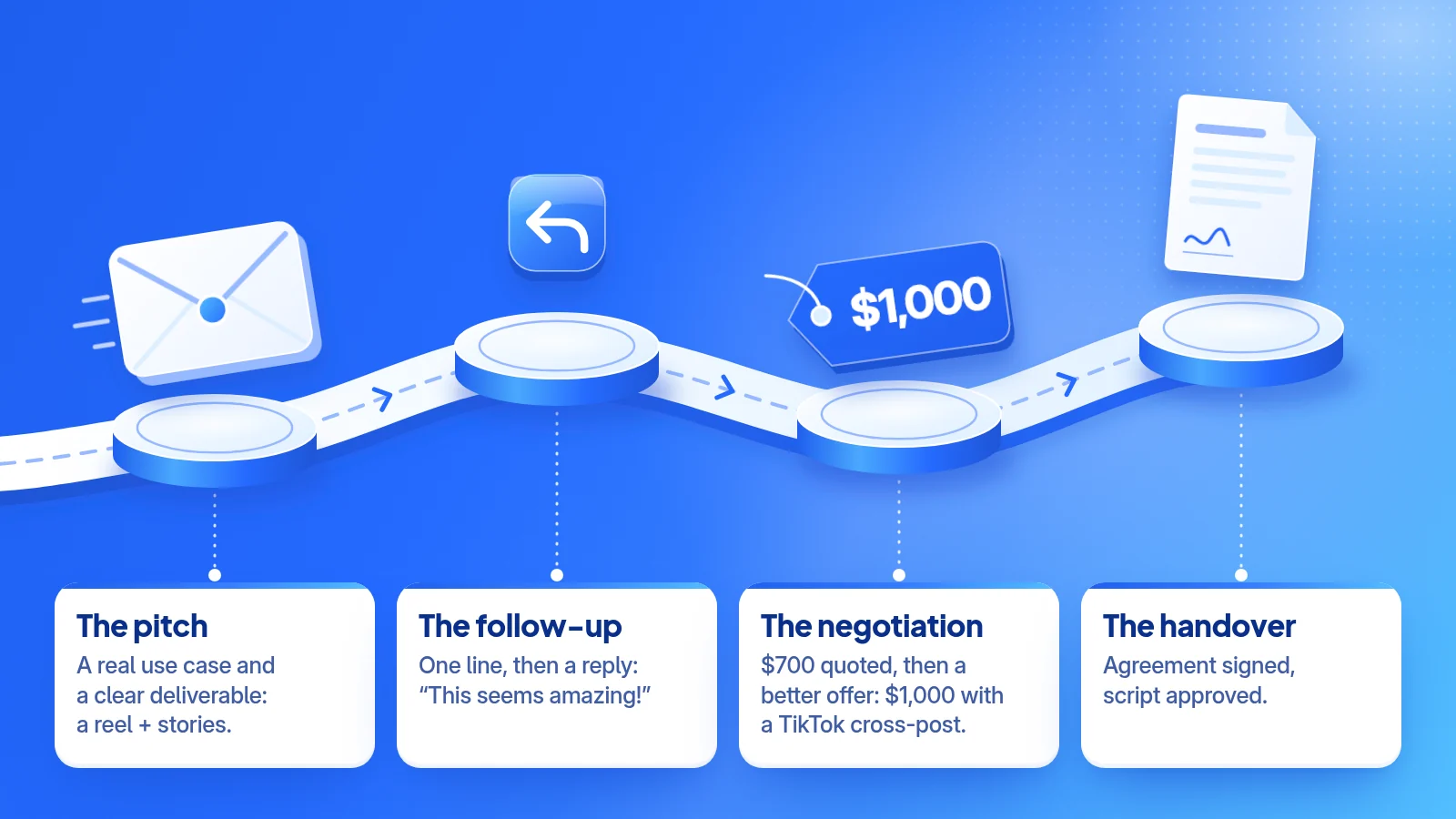
Here’s an Omnisend thread we ran for a tech and AI creator we represent, who posts Instagram Reels and TikTok. We handled the outreach, follow-up and negotiation from the creator’s outreach inbox.
The pitch: a real use case and a clear deliverable
“I’ve been using Omnisend for my own email flows and I genuinely love how easy and effective it is.”
“I’d love to create a fun reel + stories showing exactly how I use Omnisend in real life.”
In two lines, the brand learns that the creator uses the product and what the content would be.
The follow-up: one line, then a reply
“I just wanted to follow up to see if you had a chance to review my previous message.”
Omnisend replied:
“Thanks for reaching out! This seems amazing!”
The reply came after the follow-up, not the first email.
The negotiation: a clear quote, then a better offer
We quoted for the scope in the pitch:
“For this collab, I charge $700 for one Instagram reel along with supporting stories.”
Omnisend came back with:
“Do you think we can agree on 1000 USD for IG reels with stories and cross-post to you TikTok channel?”
The brand raised the fee from $700 to $1,000 and added a TikTok cross-post. When a counter-offer changes both price and scope, judge them together: is the extra money worth the extra work and reach? Here, $300 more to cross-post the same Reel was a good trade, so we accepted:
“Yes, that works perfectly for me! I’m excited to get started on this.”
| Part | USD |
|---|---|
| One Instagram reel with supporting stories (our quote) | $700 |
| The TikTok cross-post Omnisend added | $300 |
| Omnisend’s offer | $1,000 |
The handover: contract and script
Once a brand agrees, the creator takes over the thread to finish the contract, invoice and payment. The next message from the creator’s side:
“I have signed the agreement.”
Then the script went over, and Omnisend approved it:
“Thanks for sending the script. Everything looks good!”
More threads are on our real brand deal examples page. All the threads in this guide come from one tech and AI creator, but the same process applies in beauty, fitness, food, parenting, travel or any other niche: swap in your own product connection, audience proof, content idea and terms.
Should you use creator marketplaces or pitch brands directly?
Use both, but don’t let marketplaces replace your own list.
| Channel | How it works | What to watch |
|---|---|---|
| Direct outreach | You pick brands that fit and pitch a tailored idea | Contact accuracy, brand fit and follow-ups |
| Platform marketplaces | You complete a profile and receive invitations or briefs | Eligibility rules, competition and brief terms |
| Independent campaign platforms | You apply to open brand listings, including UGC briefs | Platform fees, usage rights and payment timing |
| Inbound inquiries | You turn incoming emails or DMs into clear quotes | Whether the sender is real, scope creep and budget |
Worth it
- You complete a profile and receive invitations or briefs.
- You can apply to open brand listings, including UGC briefs.
Watch out
- Eligibility rules, competition and brief terms.
- Platform fees, usage rights and payment timing.
- Don’t let marketplaces replace your own list.
Rules change, so check your own account. The official pages say:
Platform rules
TikTok One: alongside age, region and policy requirements, taking part in projects needs at least 1,000 followers plus project-specific criteria (TikTok Business Help Center).
Instagram Creator Marketplace: you join through your professional dashboard, add brand interests and build a portfolio (Meta Newsroom). Check the eligibility shown in your account.
YouTube Creator Partnerships: requirements include being 18 or older, being in the YouTube Partner Program, living in a supported region and having no active Community Guidelines strikes. YouTube also recommends turning on channel insights sharing (YouTube Help).
YouTube Open Call: invitation-only. Read each brief before you film, because the brand reviews submissions and decides which to approve (YouTube Help).
Which brands should you pitch in your niche?
Use this as a starting point, then check who is sponsoring creators in your niche right now.
| Niche | Sponsors to research | Pitch angle |
|---|---|---|
| Beauty | Skincare, makeup, haircare, beauty tools | Real application, texture and where it fits in a routine |
| Fitness | Home gym gear, apparel, training and tracking apps | A practical session or setup, with no unverified body claims |
| Fashion | Clothing, footwear, accessories | One hero piece styled for three occasions or budgets |
| Food | Ingredients, cookware, kitchen appliances | A repeatable recipe built around the product |
| Tech and AI | SaaS tools, AI apps, hardware, productivity gear | A real workflow that solves one concrete task |
| Finance | Budgeting apps, bookkeeping software, tax tools | A clear money or admin workflow, with no unlicensed advice |
| Gaming | Game launches, peripherals, chairs, streaming tools | The product inside gameplay or a desk setup upgrade |
| Parenting | Strollers, toys, mealtime gear, family apps | One daily problem solved, with children’s privacy protected |
| Travel | Luggage, booking platforms, stays, eSIMs | An itinerary with dates and covered costs agreed upfront |
| Home | Furniture, smart devices, storage, cleaning tools | A real before-and-after room or routine |
| Pets | Food, toys, grooming, pet health products | Safe, everyday use with your own pet |
| Education | Study apps, online courses, stationery | A study routine or mini-lesson using the tool |
| Lifestyle | Daily essentials, subscriptions, wellness basics | The product inside a recurring series you already run |
| B2B | CRMs, email platforms, scheduling and ops software | A workflow for founders, freelancers or agencies |
In finance, fitness, beauty and parenting especially, keep claims factual and check platform policies and local ad rules before you film.
What mistakes stop creators getting brand deals?
These are the seven I’d fix first:
- Copy-paste pitches. The same blurb to every brand, with no sign you know the product.
- No concept. “Are you open to a collab?” makes the marketer invent the idea for you.
- Cherry-picked numbers. Leading with your biggest video instead of recent median views.
- Stopping after one email. Without follow-ups, busy inboxes win.
- Giving rights away. Agreeing to ad usage, cross-posts or long exclusivity without changing the fee.
- Unchecked inbound offers. Replying to lookalike domains or vague briefs without checking the business is real.
- Going quiet after posting. Delivering, invoicing and never sending a recap or a renewal idea.
Should you do outreach yourself or get help?
You don’t need representation. DIY works if you can protect a few hours a week for research, pitching, follow-ups and negotiation. When filming fills your week, compare who actually pitches:
| Option | Who pitches brands? | Cost | Best fit |
|---|---|---|---|
| DIY | You | Your time | Creators who can pitch and follow up every week |
| Commission-only agency or manager | Often inbound-focused, unless outbound pitching is agreed | A percentage of each deal | Larger creators with steady inbound offers |
| Done-for-you outbound (Assistant Empire) | One dedicated person pitching brands in your niche from your outreach inbox | A fixed monthly fee, or a lower fee plus commission | Creators in any niche who want steady outbound and full visibility |
Before you sign with a commission-only agency, ask how many brands they pitch each week; most wait for inbound offers.
At Assistant Empire, we’ve worked with 1,000+ brands and clients across the world since 2020. One dedicated person pitches brands for you from a separate Gmail set up for your outreach, so you see every thread. We put you in front of 500+ brands that collaborate in your niche, send personalized pitches, follow up, handle replies and negotiate. When a brand agrees, we alert you, and you take over the thread to finish the contract, invoice and payment.
See how our outreach service works and our outreach pricing and plans: $300/month fixed with no commission, or $150/month plus 20% on successful collaborations. For an honest look at your positioning first, ask for a free channel review.
FAQ
How many followers do I need to get brand deals?
There’s no universal minimum for direct deals; each brand sets its own criteria (Kolect). I’d put fit, content quality and typical views ahead of follower count. Marketplaces have their own rules, such as TikTok One’s 1,000-follower requirement for projects (TikTok Business Help Center).
Can I get sponsorships without previous brand work?
Yes. Make two or three sample videos with products you already own, label them honestly as examples rather than past sponsorships, and pair them with your recent typical views.
Should I email or DM brands?
Email for the pitch: it holds links and a media kit, and keeps the terms in one searchable thread. Use a DM to ask for the right email address when a brand doesn’t list one.
Should I accept free products?
Only if you want the product and its value is fair for the work. If a brand wants heavy production, usage rights or exclusivity for a gifted item, offer a paid option instead. Gifted products can still need an ad disclosure (FTC).
How much should I charge for my first brand deal?
Start from your production time and costs, factor in your median views and niche, and price paid ad usage and exclusivity separately. Other creators’ figures are examples of specific scopes, not your rate. Our creator rates guide shows how to set a baseline.
How long does it take to land a brand deal?
There’s no fixed timeline; every brand works to its own campaign calendar and budget. Track how many brands you pitch, follow up with and hear back from, so you can see whether your targeting, pitch or follow-up needs work.
Sources
- YouTube Help: Tips for getting brand deals
- Kolect: How to get brand deals as a small creator
- SponsorRadar: How to get brand deals
- Meet Sponsors: How to pitch a brand for sponsorship
- Billo: Information for creators
- TikTok Business Help Center: How creators can sign up for TikTok One
- Meta Newsroom: Instagram Creator Marketplace
- YouTube Help: Get started with Creator Partnerships
- YouTube Help: Partner with brands through Open Call
- FTC: Disclosures 101 for Social Media Influencers
- ASA: Make clear upfront when ads are ads