To negotiate brand deals, confirm the deliverables, usage rights, exclusivity, deadlines and payment terms before quoting. Send an itemised quote, then counter a low offer with a clear fee or a smaller package that protects your rate. Define revisions and advertising permissions upfront, negotiate payment timing, and get everything in a signed contract.
When I look at a brand offer, I check three things before the fee: what the creator has to make, what the brand can do with the content, and what the deal stops the creator doing elsewhere. The number only makes sense once those are clear.
Below is the process I recommend, with copy-paste emails and real threads from our outreach. Our complete guide to brand deals covers the basics.
What should you ask a brand before you quote?
When a brand asks “What are your rates?”, find out what they want before you commit to a number. Influking’s negotiation guide recommends asking questions before you quote. A price for “one Reel” means little until you know whether the brand also wants ad rights, exclusivity or extra rounds of edits.
Ask for anything the brand hasn’t already told you:
- Goal: awareness, product education, sales, or footage for ads?
- Deliverables: platforms, formats, lengths, quantities and cross-posts.
- Usage rights: your channel only, or also the brand’s channels, website, email and paid ads? For how long?
- Whitelisting: do they want to run ads through your account, such as TikTok Spark Ads or Instagram partnership ads?
- Exclusivity: which competitors or category, which platforms, which dates?
- Approvals and revisions: who signs off, how many rounds, and when feedback is due.
- Payment: budget, currency, invoice trigger and payment date.
- Extras: raw footage, extra hooks or cutdowns, reporting, travel, or how long the post must stay up.
Email script: replying to “What are your rates?”
Hi [Name],

Thanks for reaching out. I'd love to hear more about the campaign.

So I can send an accurate quote, could you share:
- The deliverables and platforms you have in mind
- Your posting timeline
- Whether you need paid usage, whitelisting or exclusivity, and for how long
- The budget range for this partnership

As soon as I have those, I'll send a clear proposal.

Best,
[Your name]
Asking for a budget is fine, but don’t let a good thread stall over who names a number first. STAKD’s negotiation guide recommends quoting first. If the brand won’t share a budget, confirm the deliverables and send your own itemised quote. And if they ask about one clear unit, such as a price per Reel, answer straight away and say exactly what the price includes, as we did in the GoHighLevel thread below.
How should you price and structure your quote?
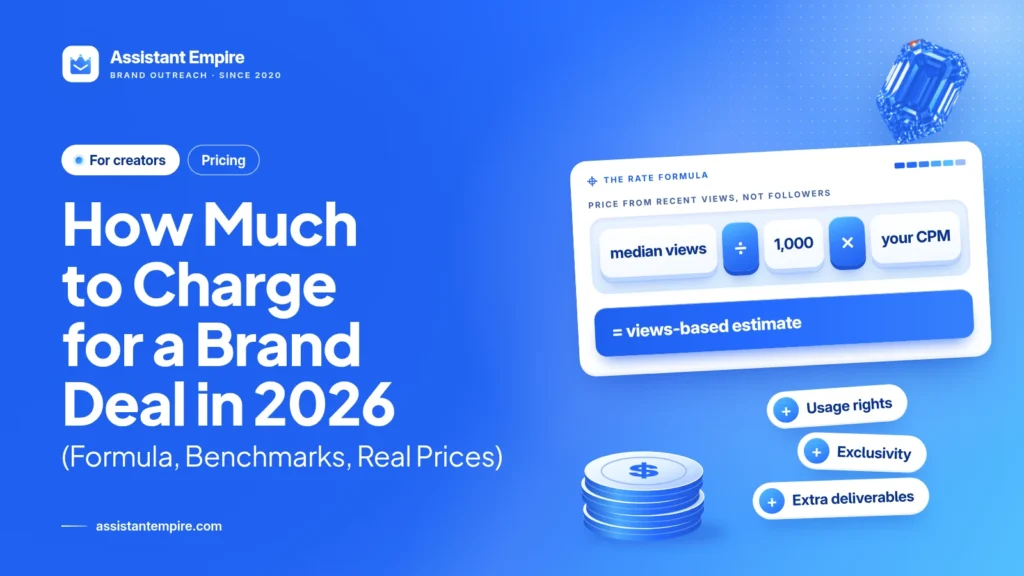
Before you send numbers, decide three figures privately: your opening quote, the fee you’d happily sign at, and your floor. They need to cover production time, costs, the rights you’re granting and any paid work that exclusivity would rule out. Our guide to setting brand deal rates shows how to build that baseline.
Then quote in line items. Selah’s counter-offer playbook recommends separating the base fee from add-ons, so you can protect the base fee and adjust the extras when a budget is tight.
| Line item | Define before pricing | What drives the price |
|---|---|---|
| Base content | Platform, format, length, quantity, scripting, filming and editing | Your production work and audience |
| Supporting deliverables | Stories, link stickers, cross-posts, extra hooks or cutdowns | Extra production and extra reach |
| Revisions | Rounds included and the fee for extra rounds | Your time |
| Organic brand usage | Which brand channels, territory and duration | Kept separate from paid ads |
| Paid usage | Ad placements, duration (say 30, 60 or 90 days) and permitted edits | How long and how widely the brand advertises with it |
| Whitelisting | Ads run from your handle, and the exact ad window | A separate fee unless clearly bundled with paid usage |
| Exclusivity | Named competitors or a narrow category, platforms and dates | The paid deals you’d have to turn down |
| Rush | A shorter turnaround than your normal schedule | Moving other work to fit it in |
| Raw footage | Which files, and what the brand may do with them | Handing over files is not the same as an ad license |
If your paid-usage line already covers whitelisting, say so rather than listing two fees the brand can’t tell apart. And quote a specific total for a defined package, not a range. A range invites the brand to pick the bottom of it.
Email script: sending an itemised quote
Hi [Name],

Thanks for the brief. Here's my quote:

- [Base deliverable, e.g. 1 Instagram Reel + 2 Stories], including
  scripting, filming, editing and 1 round of revisions: [amount]
- [Add-on, e.g. TikTok cross-post]: [amount]
- [Add-on, e.g. 30 days of paid usage on Meta]: [amount]
- [Add-on, e.g. 30 days of exclusivity for named competitors]: [amount]

Total: [amount] [currency]
Payment: [e.g. 50% on signing, 50% within 15 days of delivery]

If the budget is tighter, tell me what matters most and I'll send an
option that fits.

Best,
[Your name]
How do you counter-offer a brand deal by email?
When a brand comes back below your quote, counter once with a specific number and one plain reason: the production involved, how well your audience fits, results on similar content, or the rights they’ve asked for. STAKD’s guide gives the same advice, and says to cut scope rather than rate when a budget really is fixed. Influking suggests giving the brand two options to choose from.
Email script: countering a low offer
Hi [Name],

Thanks for the offer. For [full deliverables], my fee is [amount]. That
covers [production work and revisions] plus [usage rights and duration].

The rate reflects [one reason: production scope, audience fit or results
on similar content].

Here are two options:
- Option A: the full package for [amount]
- Option B: [smaller package] for your budget of [amount], with
  [shorter usage / no paid ads / no exclusivity]

Which works better for this campaign?

Best,
[Your name]
Option B has to remove real work or rights. If it’s the same package for less money, you’ve taught the brand that pushing works.
Support your number with an up-to-date creator media kit showing accurate audience data and relevant past work, and don’t promise sales or views you can’t guarantee.
What do real brand deal negotiations look like?
These anonymized threads come from a tech and AI creator we represent, who posts Instagram Reels and TikToks. The brands are AI and SaaS companies, but the same process works in any niche. The figures are from individual conversations, so don’t read them as market rates. You’ll find more on our real deals page.
Omnisend: a defined quote, then more scope and more money
Our pitch to Omnisend, an email marketing platform, mentioned that the creator already used it for their own email flows, and proposed:
“I’d love to create a fun reel + stories showing exactly how I use Omnisend in real life.”
After one follow-up, the brand replied: “Thanks for reaching out! This seems amazing!” We quoted a defined package:
“For this collab, I charge $700 for one Instagram reel along with supporting stories.”
Omnisend didn’t push the $700 down. They asked for more work and offered more money:
“Do you think we can agree on 1000 USD for IG reels with stories and cross-post to you TikTok channel?”
We replied: “Yes, that works perfectly for me! I’m excited to get started on this.” The agreement was signed (“I have signed the agreement.”) and the brand approved the script: “Thanks for sending the script. Everything looks good!”
What I take from it: say exactly what your price includes. When the scope is clear, a brand that wants more can add deliverables and budget together, as Omnisend did with the TikTok cross-post, instead of chipping at your fee.
GoHighLevel: a clear per-reel rate, then a 3-month proposal
After our pitch and one follow-up, GoHighLevel, the agency CRM, replied: “Do you have a media kit? Would love to hear more.” Then: “What do you general charge per reel?” We gave one number and said what it covered:
“I charge $700 per reel. This includes scripting, filming, editing, and one round of revisions if needed.”
The brand came back with a multi-month proposal at that rate:
“Lets do a 3 month deal with 1 reel per month at $700 per reel. I will send over our contract form to get started!”
What I take from it: name what’s included, especially revisions, so one Reel can’t turn into endless edits. Have a package price ready for multi-month work, and don’t offer a bulk discount before anyone asks for one.
ONLYOFFICE: holding the rate with a returning brand
The creator had worked with ONLYOFFICE, the office suite, before. Our pitch said:
“I am reaching out because our previous collaboration was highly successful and mutually beneficial, and we would love to work with you again.”
The brand replied: “We are considering collaborations for January, and definitely open for another collaboration”. We confirmed the price:
“My rate remains the same as our last project at $1500.”
Then the holidays, and silence. We sent two follow-ups, and neither mentioned price. The first: “I wanted to follow up on my last message about the AI desktop app collaboration for January.” The second:
“Now that Q1 has kicked off, I wanted to circle back on the AI desktop app collaboration we discussed for January.”
The reply:
“Sorry for the delay, I was out of office during this holiday season. The content brief is attached”.
What I take from it: silence after a quote can simply mean someone is away, as it did here. With a returning brand, keep your rate (or raise it with a reason) and don’t discount while you wait.
Fonzi: a higher rate on the renewal
On a repeat deal with Fonzi, the rate went from $400 to $500 “given the success” of the first collaboration.
What I take from it: a renewal is the natural time to ask for more money, as long as you can point to results or a bigger scope. A short version of the ask:
Hi [Name],

Thanks again for [campaign]. [One result you can show, e.g. comments,
saves or your team's feedback.]

I'd love to do [next deliverables] for [month]. Given how the first
campaign went, my rate for this round is [new amount], up from
[previous amount].

Best,
[Your name]
Sometimes there’s nothing to negotiate. AutoDS replied to a pitch at a $200 rate with “we’re in”. When a brand accepts your stated rate, confirm the details in writing and get started.
What should you say when a brand pushes back?
Use these as starting points, and keep replies short, calm and specific.
What if there’s no budget, only product or “exposure”?
Keep gifting separate from guaranteed posts. Taking a product you actually want is fine if no posting obligation comes with it. If the brand wants posts for exposure, don’t argue about your worth: state your terms and leave the door open.
Hi [Name],

Thanks for thinking of me. I'm happy to receive [product] as a gift with
no posting obligation, if that works for your seeding program.

For guaranteed [deliverables], my rate is [amount], with paid usage and
exclusivity quoted separately. If there's no budget this time, I'll pass
on guaranteed posts and would be glad to reconnect when a paid campaign
fits.

Best,
[Your name]
What if they offer CPM or performance-only pay?
CPM means cost per thousand impressions. On a CPM deal, your payout is impressions divided by 1,000, multiplied by the CPM rate.
The risk with performance-only pay is doing all the production work and earning little if the algorithm doesn’t push the post or the brand’s landing page doesn’t convert. I’d want a guaranteed base fee that covers production, with CPM or commission as a bonus on top.
Hi [Name],

I'm open to a performance element alongside a base fee: [amount]
guaranteed for [deliverables], plus [CPM rate or bonus formula].

Before we confirm, let's agree in writing the metric, the reporting
source, the measurement window, any cap and the payment date. Usage
rights and exclusivity stay as quoted.

Best,
[Your name]
What if the scope grows mid-project?
Separate genuine fixes (something you missed from the approved brief) from new requests that arrive after the script or draft was approved. Raise it before you film anything extra.
Hi [Name],

Happy to add [new deliverable, reshoot or extra revision round].

Our agreed fee covers [original scope]. Adding [request] would be an
extra [amount] and would move delivery to [new date]. If you can confirm
the updated scope, fee and timeline in writing, I'll get started.

Best,
[Your name]
What if they want perpetual usage rights?
Perpetual rights let a brand use your content, and your face if you’re in it, forever. TwoBit advises against ever granting perpetual rights at the base rate, and PitchBrand’s guide to UGC rights describes adding paid media rights separately. Offer a time-limited license with an option to extend.
Hi [Name],

My fee covers [organic use] for [duration] and doesn't include perpetual
or unrestricted rights.

I can add [paid channels, territory and duration, e.g. 90 days] for an
extra [amount], with an option to extend later at a rate we agree then.
Could you update the usage clause to match, and exclude sublicensing and
edits I haven't approved?

Best,
[Your name]
What if they insist on Net 60 payment?
Your contact may not set payment terms, but it’s worth asking: on Net 60, you’re funding the production for two months. STAKD points to shorter payment terms and deposits as things you can negotiate. Adjust the split and days to suit you.
Hi [Name],

Could we do 50% on signing and 50% within 15 days of final delivery?

If your finance team has to keep Net 60 on the balance, could we still
include the deposit and confirm exactly what starts the payment clock?
Please also flag any purchase order or vendor setup steps before I
start production.

Best,
[Your name]
Also, don’t let payment hang on a launch date you don’t control.
What if the exclusivity is too broad?
Thirty days away from two named skincare rivals is very different from six months away from every beauty, wellness and lifestyle brand. Narrow it to named competitors, or price what the wider ban costs you.
Hi [Name],

I can include exclusivity covering [named competitors or narrow
category] on [platforms] from [start date] to [end date] for [fee].

A broader category ban would block unrelated partnerships, so I'd need
to quote it separately. Could we narrow the clause to your direct
competitors?

Best,
[Your name]
How do you follow up without lowering your price?
At Assistant Empire, we usually follow up a few days after the pitch, then again about a week after that. Shift that around any launch dates or review windows the brand has given you.
The follow-up in both the Omnisend and GoHighLevel threads was one line: “I just wanted to follow up to see if you had a chance to review my previous message.” Don’t be shy about sending it. In another thread, Nim answered our follow-up with “Thank you for chasing me”. And as the ONLYOFFICE thread shows, silence is no reason to cut your quote.
When you’re chasing a proposal rather than a pitch, give the brand an easy next step:
Hi [Name],

Following up on my proposal for [campaign]. Is [package] at [fee] still
on the table, or would a smaller scope suit the budget better?

Best,
[Your name]
More timing and wording ideas are in our guide to brand deal follow-up emails.
What should you negotiate in your niche?
The process above works in every niche, including home, pets, education, lifestyle and B2B. These are the extra points I’d get in writing in nine common ones:
| Niche | What to negotiate and put in writing |
|---|---|
| Beauty | Paid ad rights using your face, whether close-ups can be recut into new ads, rules on before-and-after claims, firm license end dates |
| Fitness and health | Time for compliance review, evidence for product claims, limits on personal health or results claims |
| Food | Ingredient costs, recipe testing or reshoot fees, whether the brand can publish your recipe on its site or packaging |
| Fashion | Styling or tailoring costs, whether pieces are gifted or loaned (and who pays return shipping), exclusivity limited to direct rivals |
| Finance | Compliance sign-off, required risk warnings, who approves the script, buffer days so compliance delays don’t make you “late” |
| Gaming | Embargo dates, early build or key access, stream length and VOD retention, what happens if the launch slips |
| Parenting | Whether children appear at all, limits on paid ads or perpetual reuse of family footage, an adult-only or hands-only option |
| Travel | Who books and pays for flights and accommodation, paid filming days versus travel days, cancellation fees, weather plans |
| Tech and AI | Early or paid-plan access, testing time before scripting, reshoots caused by interface changes (outside your revision rounds), cross-platform edits |
For health products in the US, the FTC’s Health Products Compliance Guidance explains that claims need to be truthful and substantiated. Ask the brand for its evidence before you make a health claim on camera.
For financial promotions in the UK, check whether the post is issued or approved by an authorised firm, or covered by an exemption. The FCA’s guidance for content creators explains the checks. Build approval time into your schedule before you commit to a posting date.
How do you get the final deal in writing?
TwoBit’s guide to negotiating terms advises asking for every term in writing, as a package, and making sure each one appears in the signed contract. Once you’ve agreed by email, send a short recap before the brand drafts the contract. When the contract arrives, check it line by line against the recap and query anything that’s been added.
Email script: deal recap before the contract
Hi [Name],

Great, glad we're aligned. Before you send the contract, here's a quick
recap so nothing gets missed:

- Deliverables: [platforms, formats, quantities and posting window]
- Revisions: [number of rounds included]
- Usage and exclusivity: [channels, duration, paid or organic, named
  competitors and dates]
- Fee and payment: [total, currency, deposit and balance, invoice trigger]

Once the agreement reflects these terms, I'll sign and lock in
production dates.

Best,
[Your name]
Beyond the fee, TwoBit’s list of things to ask for includes cancellation fees, approval deadlines, creative control and access to campaign results.
Checklist before you sign
- ☐ Deliverables, platforms, cross-posts and posting window match your quote
- ☐ Included revisions and the price of extra work are stated
- ☐ Shipping, feedback and delivery deadlines are realistic
- ☐ Usage rights name channels, territory, duration and permitted edits
- ☐ Paid ads and whitelisting are explicit and time-limited
- ☐ Exclusivity names competitors or a narrow category, with start and end dates
- ☐ Fee, currency, expenses, invoice trigger and payment dates match
- ☐ Cancellation terms pay you for work already done
- ☐ You can show the work in your portfolio and media kit
- ☐ Disclosure is written into the brief
Agree on disclosure before you film. The FTC’s Disclosures 101 for Social Media Influencers says to disclose any material connection to the brand, including free products, clearly with the endorsement, and to put the disclosure in the video itself, not only in the description. In the UK, follow the ASA’s influencer guide. Never accept a brief that asks you to hide the relationship or claim an experience you haven’t had.
When should you walk away from a brand deal?
Walk away when the budget is below your floor and the brand won’t trim the scope, or when a deal-breaker won’t move: unlimited revisions, open-ended perpetual rights, or payment tied to vague milestones. Decline politely, because the same contact may come back with a better brief.
Hi [Name],

Thanks for talking the campaign through with me. I can't make the
current scope and terms work at that budget, so I'll pass this time.

If the budget or deliverables change on a future brief, I'd love to
revisit it.

Best,
[Your name]
The flip side: if the first offer already meets your target with clean rights and payment terms, say yes. You don’t need to counter just to prove you can.
Want help with outreach and negotiation?
Assistant Empire is a done-for-you brand outreach service for creators in every niche. One dedicated person pitches for you from your own outreach email address (a separate Gmail, so you see every thread) and puts you in front of 500+ brands that collaborate in your niche. We send personalized pitches, follow up, handle replies and negotiate. When a brand agrees, we alert you, and you take over the thread to finish the contract, invoice and payment. See how our outreach service works.
See our plans, or start with a free channel review.
FAQ
How much higher should I counter a brand’s offer?
Counter with the price your package actually requires, not a set percentage. Price the content, usage, exclusivity and payment terms line by line, and offer a smaller option if their budget is fixed.
Can small creators negotiate brand deals?
Yes. What you can charge depends on scope, content quality, audience fit and the rights the brand wants, not only follower count. Back your quote with strong samples and honest audience data.
Should I accept a gifted collaboration?
Only if the product alone is worth your time and nothing you’d normally charge for is attached, such as guaranteed posts, usage rights or exclusivity. If you do post about a gifted product, disclose it.
Should I discount a long-term brand deal?
Only for a signed, guaranteed commitment with the deliverables, schedule, payment dates and cancellation terms in writing. And don’t offer it first: in the GoHighLevel thread above, the brand proposed three months at the full $700 per-reel rate.
How many times should I counter-offer?
Once, with a clear number and, if it helps, a smaller package that fits their budget. Keep talking while the terms are moving towards something fair. If you’re both stuck below your floor, decline politely.
Sources
- Influking: Negotiating with Brands
- Selah: How to Counter a Brand Deal Offer
- STAKD: How to Negotiate a Brand Deal
- PitchBrand: How to Negotiate UGC Rights with Brands
- TwoBit: Negotiating a Brand Deal: Things to Ask for Besides the Fee
- FTC: Disclosures 101 for Social Media Influencers
- FTC: Health Products Compliance Guidance
- ASA: Influencers’ Guide to Making Clear That Ads Are Ads
- FCA: Financial Promotions: What Content Creators Need to Know Before Posting