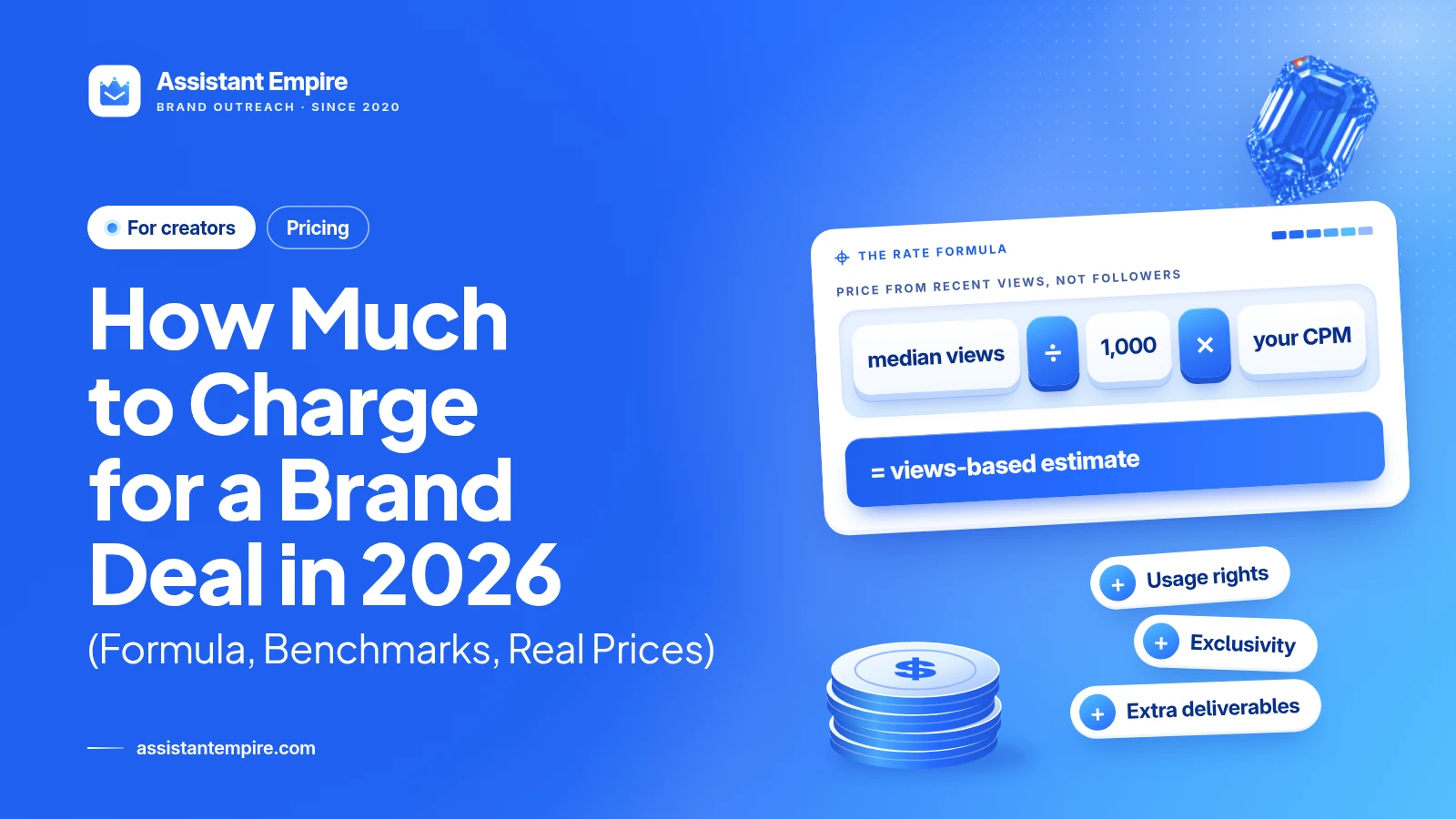
To work out how much to charge for a brand deal, take the median views of your last 10–12 comparable posts, divide by 1,000 and multiply by a CPM (cost per 1,000 views) band for that format. Check the result covers your production costs, then price usage rights, exclusivity and extra deliverables separately. Use the formula below.
How do you calculate a brand deal rate?
I recommend pricing from your recent views and the real work involved, not from a follower-count chart. Here is the formula:
Views-based estimate = median recent views ÷ 1,000 × your CPM

Base fee = whichever is higher:
  • your views-based estimate
  • your production minimum

Final quote = base fee
            + extra deliverables
            + usage rights and restrictions
            − any agreed package discount
CPM means cost per thousand. Here it is a planning rate for every 1,000 views you expect, not a promise about how many views the post will get.
Step 1: Find your median views, not your average
Take your last 10–12 comparable posts on the platform you’re quoting for. Sort the view counts from lowest to highest and take the middle one (with an even number of posts, average the middle two).
The median matters because one viral post distorts an average. If nine Reels get 10,000 views and one gets 210,000, your average is 30,000 but your median is 10,000. Quote off the average and you’re asking a brand to pay for three times the views your posts normally get.
To keep the comparison fair:
- Separate Reels, TikToks, Shorts and long-form YouTube.
- Compare posts at a similar age, for example views at 30 days.
- Leave out paid boosts if your analytics split organic and ad views.
- Track past sponsored posts separately once you have enough of them.
For Instagram feed posts and Stories, use median reach or impressions from your analytics and compare them with a benchmark built on the same measure.
Step 2: Pick a CPM band for the format
Pick a band from the next section, then decide where you sit in it. To justify the top of a band, I look for three things: an audience in the countries and age groups the brand sells to, comments where people ask buying questions, and past evidence of clicks or sales. A niche label on its own isn’t enough.
Step 3: Check your production minimum
Add up the real time and costs of concepting, testing the product, scripting, filming, editing, admin and revisions. That total is your floor.
Say your views-based estimate is $180, but the shoot and edit cost you at least $300 in time. Your base fee is $300 (illustrative figures, not market rates). The floor replaces the low estimate, so don’t add those production hours a second time.
Step 4: Price everything else as its own line
Your base fee covers making the content and posting it once on your own channel. Everything else is a separate line: paid ad usage, whitelisting (also called allowlisting), exclusivity, raw footage, rush deadlines and cross-posting.
What CPM should you use in 2026?
These are published planning bands in US dollars for one organic post. Treat them as starting points, not guaranteed payouts.
| Format | Published band (per 1,000 views or impressions) | Source |
|---|---|---|
| Instagram Reel | $15–$35 | Karat |
| Instagram feed post | $10–$30 | Karat |
| Instagram Story | $5–$15 | Karat |
| TikTok / short-form video | $10–$30 | Karat’s creator pricing guide |
| YouTube integration | $20–$60 | ThoughtLeaders |
| Dedicated YouTube video | $30–$80 | Karat |
Match the measure before you compare: a band quoted per 1,000 impressions belongs next to your impressions, not your views. ThoughtLeaders gives its typical integration range as $0.02–$0.06 per view, the same as $20–$60 per 1,000.
An integration is a sponsored segment inside a normal video. A dedicated video is about the brand from start to finish, so it takes more work and should cost more.
Measured deals don’t always land inside these bands, in either direction. Kolect’s 2026 benchmarks put the median realized CPM at $6.73 on TikTok (below Karat’s short-form band), $17.96 on Instagram (inside Karat’s Reel band) and $74.24 on YouTube (above ThoughtLeaders’ integration band). Use a band to pick a starting point, then let brand replies tell you whether to move.
No band for your format? For newsletters, livestreams or X threads, build a rate from that placement’s own numbers instead of reusing your Reel price.
Why do published brand deal rates disagree?
Two guides can quote very different prices for the same post, and usually neither is wrong. They are measuring different things.
| Source | Figure | What it measures |
|---|---|---|
| Ames Create | $7–$10 per 1,000 views | How brands in its log of 124 brand deal conversations priced views |
| Ames Create | $1.55–$4.72 per 1,000 views | What brands paid, divided by the views actually delivered |
| Kolect | $15.46 median realized CPM | Fee per 1,000 views actually delivered |
| Kolect | $22.83 per 1,000 average views | Fee measured against the creator’s average views |
| Virev | $635 per Instagram post (micro tier); $43 per 1,000 views | Median price by follower tier; price per 1,000 views across all tiers |
| Aspire | $250 median nano Instagram Reel fee | What creators reported charging in its survey |
The gap comes down to four things.
1. What the fee is divided by. The same fee divided by impressions, views or followers gives three different “rates”. Even one report can show two: Kolect sets its $15.46 against views actually delivered and its $22.83 against the creator’s average views.
2. Expected versus delivered views. A price agreed before posting is based on expected views; a realized CPM is worked out afterwards, on the views the post actually got. Take a hypothetical $1,000 fee agreed against 50,000 expected views: a $20 planning CPM. If the post reaches 100,000 views, the realized CPM is $10, though the creator was paid the same.
3. Where each study draws its tiers. Aspire’s nano tier runs from 2,500 to 25,000 followers; Virev’s micro tier runs from 10,000 to 100,000. An account with 18,000 followers is “nano” in one study and “micro” in the other, so tier figures from different reports don’t line up.
4. Asking prices versus paid deals. Rate guides suggest what to ask, and Aspire’s figure is what creators say they charge. Ames Create’s delivered figure and Kolect’s realized CPM measure what brands paid against views. Ames Create notes that rate guides put Reels at $15–$35 per 1,000 views, well above what brands in its own log priced or paid.
What does the formula look like for different creator sizes?
These are illustrations, not Assistant Empire deals. The audiences, views, floors and add-ons are invented to show how the formula and the published bands fit together.
| Illustrative creator | Views-based estimate and base fee | Add-on | Illustrative quote |
|---|---|---|---|
| Beauty: 8,000 followers, 12,000 median Reel views | 12 × Karat’s $15–$35 Reel band = $180–$420. At $20 CPM that’s $240, below a $300 floor for a full shoot day, so the base is $300. | 30 days of paid ad rights: +30% (+$90), inside Impact.com’s 20–50% usage range | $390 |
| Fitness: 60,000 followers, 40,000 median TikTok views | 40 × Karat’s $10–$30 short-form band = $400–$1,200. Strong engagement puts it mid-band: $20 CPM, $800. | 60 days of supplement exclusivity: +25% (+$200), inside Impact.com’s 20–100% exclusivity range | $1,000 |
| B2B tech YouTuber: 200,000 subscribers, 50,000 median long-form views | 50 × ThoughtLeaders’ $20–$60 integration band = $1,000–$3,000. An audience that buys software supports the upper half: $50 CPM, $2,500. | Custom demo built in a test account: +$400 for the extra production time | $2,900 |
Follower count is context, not the price. The beauty creator has 8,000 followers but prices from 12,000 median views and a day’s work, not from a “nano” rate chart.
What should you charge extra for?
Impact.com suggests broad starting points of 20–50% of your base fee for usage rights and 20–100% for exclusivity. Where you land should depend on how long the rights or restrictions last and how broad they are, so tie every percentage to named channels and fixed start and end dates.
| Request | Define this before you price it |
|---|---|
| Organic reuse | Which brand channels (social, website, email), how long, which countries, and whether edits are allowed |
| Paid ads | Ad platforms, license length, permitted cutdowns and renewal terms |
| Whitelisting / allowlisting | Ads run through your handle: end date, creative approval and spend limits |
| Exclusivity | Named competitors or a narrow product category, with exact dates |
| Rush delivery | The weekend editing or rescheduling a short deadline forces |
| Raw footage and extra versions | Unedited files, alternate hooks, cutdowns, other aspect ratios |
| Extra revisions | Where small edits end and a reshoot begins |
| Cross-posting | Each extra platform, plus any re-editing to fit it |
Be careful with exclusivity. “No competing skincare serums for 30 days” and “no beauty, haircare or wellness brands for six months” are different deals, because the second blocks far more of your other income.
Offer a bundle discount only when a multi-post deal really saves you pitching or setup time, and put every term in writing.
How does your niche change your rate?
I lean toward the upper half of a band for finance, B2B and tech when the audience shows real buying intent, such as people asking about pricing, features or switching tools. For broader lifestyle and entertainment channels, the case rests more on attention, creative quality and audience fit.
| Niche | What to check before you quote |
|---|---|
| Beauty | Days of product testing, lighting, close-up skin shots, and requests for paid usage on a hook that performs |
| Fitness | Gym access or location permits, safe demonstrations, and how wide any supplement or apparel exclusivity is |
| Food | Ingredients, recipe development, test cooks and styling time |
| Fashion | Sourcing outfits, styling changes, seasonal deadlines, and retailer exclusivity that could block your usual links |
| Finance | Clear audience trust supports higher rates; regulated brands may need compliance review, so cap revision rounds in writing |
| Gaming | Price VOD segments and livestream integrations separately, and define chat mentions, overlays and pinned links |
| Parenting | Whether children appear on camera, tight limits on usage, and broad household-category exclusivity |
| Travel | Keep your fee separate from flights, accommodation and multi-day shoots so expenses don’t eat your margin |
| Tech / AI / B2B | Software onboarding, test accounts and custom workflow demos; high-value buyers can justify stronger rates on modest views |
Put your audience’s top countries and age split in your creator media kit, because a brand selling in specific markets needs to know how much of your audience it can reach.
How do you price UGC, gifted and affiliate deals?
Not every inquiry is buying the same thing, so work out what the brand is paying for before you quote.
| Deal type | What the brand is buying | How to price it |
|---|---|---|
| Sponsored post | Content plus distribution to your audience | Views formula or production floor, plus add-ons |
| UGC (no posting) | Content plus a license to use it | Production cost, extra hooks or ratios, and the usage term |
| Gifted | Product in exchange for an optional or agreed post | Accept only if the product is worth your time and there are no hidden ad rights |
| Fee plus commission | A smaller fixed fee plus tracked affiliate sales | Keep the fixed part above your costs; check the tracking window and payout rules |
UGC without posting. If a brand wants videos for its own channels, your follower count doesn’t set the price, because you aren’t supplying reach. Quote the production work, the deliverables (say, three hooks in two aspect ratios), a revision limit and the usage term. If the brand later wants the video on your feed too, add your posting fee.
Gifted offers. A no-strings gift is very different from a “gifted” deal that expects a Reel, three Stories and paid ad rights. Don’t value the product at its retail price; ask whether it’s worth the hours the content will take. If not, reply with a paid starter rate (script 3 below) or decline politely.
What do real brand deal prices look like?
These prices come from threads for a tech and AI creator we represent on Instagram Reels and TikTok. They are individual negotiations, not market averages. The brands are AI and SaaS companies, but the same process applies in any niche, from beauty and fitness to food and parenting: a relevant pitch, a clear scope, follow-ups and a written agreement.
GoHighLevel: $700 per Reel, then a three-month deal
After a personalized pitch and one follow-up, GoHighLevel asked for a media kit and what the creator charges per reel. We gave the price and the scope together:
I charge $700 per reel. This includes scripting, filming, editing, and one round of revisions if needed.
The reply:
Lets do a 3 month deal with 1 reel per month at $700 per reel. I will send over our contract form to get started!
The brand proposed three months itself, at the full rate. Stating exactly what a price covers settles the scope before anyone starts negotiating.
Omnisend: $700 quoted, $1,000 offered for more
After our pitch and one follow-up, Omnisend replied with interest. We quoted:
For this collab, I charge $700 for one Instagram reel along with supporting stories.
The brand came back with more money and more scope in the same message:
Do you think we can agree on 1000 USD for IG reels with stories and cross-post to you TikTok channel?
We accepted (“Yes, that works perfectly for me!”) and the agreement was signed. Keep cross-posting as its own line on your rate card, so that when a brand adds a platform, the price has a reason to move with it.
ONLYOFFICE: holding $1,500 on a repeat deal
ONLYOFFICE had worked with the creator before. When the brand said it was open to another collaboration in January, we kept the price where it was:
My rate remains the same as our last project at $1500.
The thread then went quiet over the holidays. We followed up twice; the second message read, “Now that Q1 has kicked off, I wanted to circle back on the AI desktop app collaboration we discussed for January.” The reply:
Sorry for the delay, I was out of office during this holiday season. The content brief is attached
The silence was about timing, not price, and the $1,500 rate held.
Fonzi and AutoDS: a raise on renewal and a quick yes
Fonzi’s repeat deal went from $400 to $500 “given the success” of the first one. AutoDS answered a pitch at a $200 rate with “we’re in”.
One creator, one niche, deals from $200 to $1,500. Price each deal on its scope, not on a single number from a chart. There are more examples on our real deals page.
What should your rate card include?
Keep your walk-away number private. Show a starting price for each format and make clear that the final quote depends on scope and usage.
CREATOR RATE CARD
Name / niche:
Main platforms and audience locations:
Median views by format (last 10–12 posts):
Measurement window (e.g. views at 30 days):

BASE DELIVERABLES (ONE ORGANIC POST)
Instagram Reel: from $___
TikTok video: from $___
YouTube integration (___ seconds): from $___
Instagram Stories: $___ for ___ frames
UGC video (no posting): from $___

INCLUDED IN THE BASE FEE
Concept, scripting, filming and editing
___ revision round(s)
One organic post on: ___
Minimum time the post stays live: ___

ADD-ONS
Cross-post to another platform: $___
Extra hooks / cutdowns / raw footage: $___
Organic reuse by the brand (channels and term): ___ / $___
Paid ad usage (platforms and term): ___ / $___
Whitelisting / allowlisting (handle and term): ___ / $___
Category exclusivity (competitors and dates): ___ / $___
Rush turnaround: $___

TOTAL AND CURRENCY:
PAYMENT TERMS (e.g. 50% upfront, 50% net-30):
QUOTE VALID UNTIL:
What do you say when a brand asks for your rate?
Adapt these three scripts. If you’re opening the conversation yourself, start with our pitch email templates.
Script 1: Quote a starting rate and confirm the scope
Hi [Name],

Thanks for the details. Before I confirm a final quote, could you
share your posting dates, how many revision rounds you expect, and
whether you need paid usage, whitelisting or exclusivity?

For [deliverable, e.g. one Instagram Reel], my rate starts at
$[amount]. That covers scripting, filming, editing and one round of
revisions. Usage rights and exclusivity are priced separately once
we agree the term.

I'll send a full breakdown as soon as I have those details.

Best,
[Your name]
Script 2: Offer a smaller package for a lower budget
Hi [Name],

Thanks for sharing your budget. At $[budget], I can do [smaller
deliverable, e.g. one TikTok with no cross-post or paid usage],
including [scope].

The $[original quote] package adds [extra deliverables, cross-posting
or usage rights]. Would the smaller option work for this campaign?

Best,
[Your name]
Script 3: Turn a gifted offer into a paid test
Hi [Name],

Thanks for thinking of me for [Product]. I'm happy to receive gifted
products with no posting commitment, but guaranteed content is paid
work for me because it takes production time and a slot in my
calendar.

If you have budget for a test, I can create [one short-form video /
a Story set] covering [scope] for $[starter rate]. Would that fit
this quarter's plans?

Best,
[Your name]
What if the brand goes quiet?
Don’t read silence as a no, and don’t cut your price to break it. Our outreach follows up a few days after the first message, then again about a week after that. On the ONLYOFFICE thread, the brief arrived after the second follow-up. On another thread, Nim answered our follow-up with:
Thank you for chasing me
Send a polite nudge from our follow-up email templates before you think about discounting.
When should you raise your rates?
Review your rate card when:
- Your median views have risen steadily for two or three months.
- Production gets more complex or each post takes longer to make.
- Good brand inquiries start to outnumber the slots you have each month.
- A brand comes back after a campaign went well, as Fonzi did when the rate moved from $400 to $500.
Keep a simple log of what you quoted, what closed, what each deal included and the hours it took. It will soon show you which deals were worth doing.
What should you check before sending a quote?
- ☐ Your median comes from your last 10–12 comparable posts, not a viral outlier.
- ☐ The quote clears your production floor.
- ☐ Usage rights, whitelisting and exclusivity are priced separately, with end dates.
- ☐ Revision limits, currency, payment terms and cancellation terms are in writing.
- ☐ You know where the ad disclosure will appear in the content itself.
In the US, the FTC’s guidance is to disclose any material connection with a brand, including free products, and for video, to put the disclosure in the video itself rather than only in the description (FTC, Disclosures 101 for Social Media Influencers). In the UK, follow the ASA’s ad-labelling rules; elsewhere, check your local equivalent.
Want help getting your rate in front of brands?
A good rate only matters if the right brands see it. At Assistant Empire, one dedicated person pitches brands for you from a separate outreach Gmail, so you see every thread. That puts you in front of 500+ brands that collaborate in your niche. We personalize each pitch, follow up, handle replies and negotiate. When a brand agrees, we alert you, and you take over the thread to finish the contract, invoice and payment.
We’ve done this since 2020 and have worked with 1000+ brands and clients across the world. See how our outreach service works, compare plans and pricing or ask for a free channel review. For the bigger picture, start with our guide to brand deals.
FAQ
How much should I charge with 10,000 followers?
Follower count alone won’t tell you. Price from your median views, a CPM band for the format and your production floor. Two 10,000-follower accounts might get 1,500 and 25,000 median views, and their rates should differ to match.
Should I charge the same for a Reel and a TikTok?
No. Price each platform on its own numbers. Kolect’s median realized CPM is $6.73 on TikTok against $17.96 on Instagram, and your views and editing time will differ too. If a brand wants both, price the second platform as a cross-post or a separate deliverable.
How much should I charge for a YouTube integration?
Divide the median views of your last 10–12 long-form uploads by 1,000 and multiply by ThoughtLeaders’ typical $20–$60 band ($0.02–$0.06 per view). Move up for custom demos or an audience with clear buying intent, and make sure the result clears your production minimum.
Should usage rights be included in my rate?
Not by default. Keep organic reuse and paid usage out of your base fee, and spell out which channels can use the content, for how long, and whether paid ads or whitelisting are included. Impact.com’s broad starting range for usage rights is 20–50% of the base fee.
Should I guarantee views?
I’d quote a fixed fee with no view guarantee, because you don’t control distribution. If you do agree to a performance floor, define which views count, the measurement window, a cap on make-good content and when payment is due.
Should I accept free products for my first collaboration?
Only if the product is genuinely worth your time and the deal doesn’t tie you to heavy deliverables or broad usage rights. New creators can still ask for a fee, or answer a gifted offer with a modest starter rate.
Sources
Assistant Empire examples come from our anonymized outreach threads.
- Karat: How Much to Charge for a Brand Deal
- Karat: How Creators Should Price Brand Deals
- ThoughtLeaders: Understanding YouTube Sponsorship Rates
- Ames Create: What Brands Actually Pay Creators
- Kolect: Influencer CPM Benchmarks 2026
- Virev: Influencer Rates Study
- Aspire: Influencer CPM and rates by tier
- Impact.com: How Much to Charge for Usage Rights
- FTC: Disclosures 101 for Social Media Influencers